Artificial Intelligence & Music.
The other arts persuade us, but the music takes us by surprise.
AI music offers a complex mix of revolutionary benefits and significant drawbacks, making it, depending on the application, both a powerful tool and a controversial threat. It is generally regarded as a game changer for efficiency and accessibility, but as a threat to authenticity and human livelihoods.
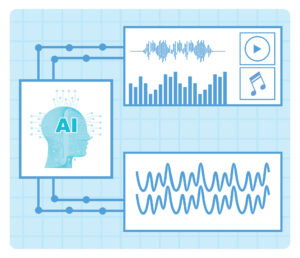
Artificial Intelligence (AI) has transformed music production at breakneck speed. It is no longer merely a futuristic concept, but an everyday tool used in some form by 87% of artists, ranging from creative support to technical production. AI can generate complete songs, break through creative blocks, and drastically accelerate mixing and mastering processes.
Benefits (the "Pro" side)
Increased efficiency and speed: AI can generate ideas, backing tracks, and complete compositions within seconds, significantly accelerating the production process.
Idea Generation: Tools like Suno and Udio can produce complete songs, including vocals, in seconds based on text prompts (e.g., "cheerful pop song with piano").
Melodies and Harmonies: AI can assist in composing chord progressions and melody lines.
Style Transfer: AI can analyze the style of a well-known artist or genre and apply it to a new composition.
Songwriting: AI helps with writing lyrics, finding rhyme schemes, and structuring songs.
AI in Technical Production (Mixing & Mastering)
AI-driven plugins and software take over time-consuming technical tasks, allowing producers to focus on the creative aspect.
Automatic Mastering: Services like LANDR analyze the frequency balance and dynamics of a song and apply professional mastering.
Intelligent Mixing: Plugins (such as iZotope Neutron) analyze tracks and suggest EQ, compression, and balance settings to ensure a clear mix. Audio Restoration: AI is used to remove noise or separate instruments from an already mixed recording (voice separation).
Democratization of creation: Tools such as Suno and Udio enable people without musical training to create high-quality, polished music.
Overcoming creative blocks: Artists use AI to generate new melodies, chord progressions, or rhythmic patterns to gain inspiration.
Cost-effective production: It reduces the need for expensive studio time and session musicians for independent artists.
Personalization and functionality: AI can create personalized, functional soundscapes for focus or sleep (e.g., Endel) and makes it possible to customize music for video games.
Disadvantages (The "negative" side)
Loss of human touch: Music produced by AI is often criticized for the lack of emotional depth, nuanced expression, and the "soul" of a human performance.
Job losses: The efficiency of AI threatens the income of session musicians, mix engineers, and composers, particularly in the jingle and background music sectors.
Ethical and legal issues: Many AI models are trained on unlicensed music, leading to lawsuits regarding copyright, intellectual property, and fair compensation.
Homogenization of music: As more creators use the same AI tools, there is a risk that music will become formulaic, repetitive, and less diverse.
Market saturation: The ease with which music can be created using AI could flood streaming platforms, making it harder for original human artists to stand out.
The future: co-creation versus replacement.
Impact and Controversies.
The rise of AI in music is causing a major shift in the industry:
Accessibility: Music production is becoming more accessible to non-musicians, leading to an explosion of new content.
Important AI music platforms.
There are various AI brands and platforms that can automatically create complete songs, including vocals, instrumentation, and lyrics. The most prominent tools that generate complete songs based on text prompts are:
Top AI Song Generators (Complete Songs)
Suno AI (Suno): Currently considered one of the best and most widely used AI music generators. Based on a text description (prompt), this program creates complete songs with high-quality vocals and music within a minute.
Udio: This tool is Suno's biggest competitor and is known for its very realistic voices and high production quality. It generates complete songs based on textual input.
AIVA (Artificial Intelligence Virtual Artist): This assisted AI composer can quickly create new songs in over 250 styles and is suitable for both beginners and professionals.
Loudly: This AI generator quickly creates studio-quality music. Users can choose genres, mood, and energy to instantly generate complete songs. MusicCreator AI: This specialized tool combines text (lyrics) and music into complete songs.
Boomy: This allows users to generate music in seconds and publish it directly to streaming platforms.
Google Gemini (via Lyria 3): Google integrates AI music generation into Gemini. This creates 30-second tracks with vocals and lyrics based on prompts.
Soundraw: This program is known for modifying song structures and is often used in conjunction with video editing tools such as Canva.
Key features of these AI brands:
Text-to-song: A description is entered (e.g., "a pop song about summer, cheerful"), after which the AI creates the song.
Vocals & Music: Most of the mentioned tools (especially Suno and Udio) generate both the melody and the vocal lyrics.
Licenses: Some platforms, such as Soundraw, focus on royalty-free music for video creators.
These tools make it possible to quickly create a complete, new piece of music without a musical background.
Ethics and Copyright: There is much debate regarding training AI models on protected works. Rights organizations such as Dutch copyrights Buma/Stemra emphasize that permission is required for the use of existing music. Fear of replacement: Many professionals fear that the market will be flooded with 'cheap' AI music, causing the value of human creativity to decline.
Transparency:
Most professionals in the industry do not view AI as an outright replacement, but rather as a disruptive tool that, if used correctly, functions as a collaborative partner or assistant.
The "hybrid" approach: Using AI for initial brainstorming sessions or mixing/mastering (e.g., LANDR), while retaining human creativity for composition and emotional expression.
The 30% rule: A proposed approach is for AI to handle 70% of the repetitive/technical work, while humans retain 30% for oversight and creative judgment.
The emergence of new roles: The future could involve humans specializing in AI curation, prompt engineering for music, and the legal management of AI-assisted intellectual property.
The integration of AI is still in its infancy. Experts expect AI to become a standard tool in every studio, with the focus shifting from technical knowledge to 'curation' (selecting and refining AI-generated ideas). Despite the fear, many pioneers are using it to create new sounds that traditional Impact and Controversies